
|
|||||||
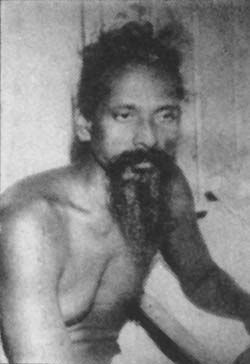
Address of Warige Wanniya to the UNUnited Nations Working Group on Indigenous People
|

|
|
Warige Wanniya
|
The United Nations Working Group on Indigenous People (UNWPIP), which held its 14th session in 1996, in a letter to the President urged the Government of Sri Lanka to recognise and respect the rights of the Wanniyala-aetto to maintain their traditional subsistence and live according to their culture. The working group has also urged the Government to "cease all acts of repression." |
"We come here to join in the work of the Working Group on Indigenous population by contributing to the review of developments considering the diverse situations and aspirations of the world's indigenous peoples.
"We draw your attention to the land of Sri Lanka and of the specific condition of our people, the Wannyala-aetto. Most indigenous participants here are familiar with the Sinhalese and the Tamil populations of our country but little is said about us, the first occupants of the island. Archaeological estimates link our ancestry in Sri Lanka as far as 130,000 years ago or possibly even 500,000 before presence.
"On November 9, 1983 the central governments of Sri Lanka turned the last of our forest territory into a national park. The Maduru Oya National Park, and thereby transformed us from being hunters and gatherers into poachers. Our traditional way of life, became a criminal offence in the eyes of the English Common Law, a law from a foreign country that we do not understand. We were driven out of our traditional homeland to flat rice-fields, labeled "System C", in the language of the Accelerated Mahaweli Development Project. Our last hunting grounds comprised about 51468 hectares was designated a combined "catchment area" for a gigantic hydroelectric cum irrigation project, the Mahaweli Development Project and a Forest and Wildlife Reserve. At the present time our numbers have dwindled to approximately 2000 individuals and until 13 years ago we maintained a continuity of our hunting-gathering/ swidden-fallow cultivation subsistence.
"We the Wannyala-aetto, which means forest-beings are not allowed to remain in the forest. The national park regulations proscribe people from hunting, picking flowers, collecting honey, lighting a, camp fire, much less allowing anyone living in the park.
Instead, development programme villages awaited us with schools, shops, health clinics, "proper" clothes, i.e. English school uniforms for our children to go to Sinhalese schools, Buddhist temples and modem means of communication. Two and a half acres of irrigable land were allotted to each family. Two acres for cash cropping and the remaining half acre was for domestic consumption. We were expected to learn to become agriculturalists and live in a "civilized" way, have a "civilized" language and religion. For the first two years, we were provided with free material to resettle. We received artificial fertilizers, pesticides, hybrid seeds to cultivate, and we obtained Triposa (a nutritious mixture of three kinds of flour). Lux soap (with a nice white lady on the wrapping paper), and milk powder. Implied was the promise that this would be an everyday reality for us in the new resettlement village if they moved and abandoned our ancient lifestyle. We were expected to move from the tropical forest to the "rehabilitation villages" by free will. The government says no one was forced. If "force" is armed forces, the statement cannot be argued. We had the choice to stay on, in the remaining land bordering the dams. The risk however of flooding during the monsoon rains was a threat to consider. We were not allowed to live off the land. Furthermore, no person is allowed to enter the National Park, except for the purpose of observing the fauna and flora, according to the Fauna and Flora Ordinance. We are arrested, imprisoned and brought to courts if we go inside. There are electric fencing, barriers, and national park guards aimed to shoot if we trespass the borders.
Our relationship with our environment is changing. We were the custodians of the jungle throughout generations. Now the jungle is no longer ours and we do not feel responsible for its maintenance. A "Grab and Run" philosophy has developed. We sneak inside, kill what we can get and then run outside again. We would not do that before. We were taught not to kill an animal drinking water, because we all need to drink water. We would not kill a pregnant mother; a deer a sambhur or another pregnant animal. We would not kill a four-legged mother giving milk to her small ones. The very land we, the Wannyala-aetto, shared with other beings (-aetto) is also shared by our ancestor forefathers, gods and goddesses and forest spirits. We are now alienated from them. Our very name, the Wannyala-aetto have no meaning if we cannot live in the forest. Because of the 1983 prohibition of maintaining our traditional subsistence new diseases appear. Since we cannot collect honey we have to add sugar to our diet. My own son is one of the first cases of diabetes in our community. Obesity, is another problem, and with that, high blood pressure. Since foraging is forbidden, we cannot track game for days and days as we did before. We cannot exercise the same physical hard work as we did before 1983. Alcoholism is also gradually penetrated into our society. You who were with us during the Preparatory Meeting at the World Council of Churches this year may have noted there were three of us here. Today we are only two. With the permission of my brother-in-law, Una Pana Warige Sudu Bandiya, I am sharing with you the reason why he is not present at this presentation. He has been introduced to alcohol by unscrupulous outsiders. They offered him the opportunity to forget about his helplessness and grim future by the temporary relief of alcohol. I was not aware of how far the disease had taken him when I asked him to join me to this WGIP-meeting. My brother-in-law is suffering from strong withdrawal symptoms.
The frustration of the futility in managing our own way of life expresses itself also another way. 'Madness' falls upon us. These are bad spirits that possess us. To cure this we perform healing ceremonies where most of our society members cooperate. We give the sick person care and attention and we visit him/her often to give strength. The healing ceremonies have increased considerably only during the last year. Analysts say this may be a sign of a society in disintegration, a dying from the inside, a destruction of the foundation of our beings, the Wannyala-aetto. By the loss of the jungle and our subsistence we can no longer call ourselves Wannyala-aetto, the forest-being and we have come here to find a solution to this. We want to survive not only as a people but also as a culture.
The solution of our problem and those of other indigenous people in; similar situations is very simple; let us go back to our traditional land, specifically the Maduru Oya National Park. Those of us who recognize our need to return as the only answer for our survival as the Wannyala-aetto should at least be given the opportunity to do so. We are not members of the majority people, we are; not Sinhalese, neither Tamils nor are we criminals. We are simply a humble people attempting to remain true to who we are.
For the indigenous and non-indigenous participants at this WGIP meeting who would like to support our cause, we ask you to sign a resolution to the government of Sri Lanka. Your support will be greatly appreciated. The list will be ready later today.
We will also give a slide presentation about our culture in room XXII on Thursday at 3-4 p.m. We wish to welcome you to attend our presentation. Thank you for your kind attention.
Resolution of Indigenous participants to the 14th session of the united Nations Working Group on indigenous peoples in support of the Wannyala-Aetto (Veddahs), indigenous people of Sri Lanka
To:
Her Excellency Mrs. Chandrika Bandaranaike Kumaratunga, Min. of Financial
& Planning & Ethnic Affairs & National Integration. Presidential
Secretariat, Colombo 1, Sri Lanka
We the undersigned indigenous peoples and nations participating in the 14th Session of the United Nations Working Group on Indigenous Peoples, 29 July-2 August 1996, issue this resolution in support of the Wannyala-aetto (Veddahs), Indigenous People of Sri Lanka. We hereby:
- Recognize the legitimacy of the Wannyala-aetto Peoples' struggle for a legal recognition by the Sri Lankan government, as the indigenous peoples of that country and their right to maintain their own religion, learn and talk their own language and to continue carrying out their subsistence according to their own culture;
- Endorse the Wannyala-aetto land claims statement as herein attached to this resolution;
- Urge the government of Sri Lanka to recognize and respect the rights of the Wannyala-aetto people to live their ancestral and cultural way as the original people of the land;
- Urge that the government of Sri Lanka cease all repressive measures against the Wannyala-aetto people, including the arrest and incarceration of the Wannyala-aetto people for merely practicing their traditional and ancestral way of life;
- Pledge to support the Wannyala-aetto people in their efforts to protect their rights to their land, their heritage, culture, and survival as a people.
Land claim
- We, the Wannyala-aetto, the indigenous people of Sri Lanka, want to have the 1983 Sinhalese land acquisition returned to us. The area is 198.72 sq. miles (or 51,468 hectares.). It is our hunting grounds, now, labeled as the Maduru Oya National Park. For borders, see Gazette 270/9 1983.11.09.
- We want to return to our traditional migration routes. Areas recognized by us as Kudatalawa, Kiuliaya, Kotabakinni, Kaeragoda, Bullugaha-dena and Kandeganville.
- These are the places where we usually build our houses, where we organize swidden and fallow-cultivations, and arrange small plots of horticulture.
- The remaining part of the Maduru Oya National Park should serve, as the hunting and gathering ground of the Wannyala-aetto.
- Nobody but the Wannyala-aetto people should be able to live and make a living inside the National Park. We will be responsible for the determination of Wannyala-aetto identity.
- The Wannyala-aetto who were relocated to rehabilitation Villages, Henanegalla, and other land offered by the Mahaweli Development Project may return to their villages of origin.
- The Wannyala-aetto will not allow encroachers, neither government (State Timber Corporation, Tourist Board, Development Projects, religious institutions or military training camps) nor private entrepreneurs/projects or private individuals inside the park.
- National Park guards will help the Wannyala-aetto to keep encroachers outside. Game meat is harvested for private consumption only. Honey and medical herbs are sold.
- The objective of the Wannyala-aetto people is to maintain our culture, apart from the dominant society, and protect it against those who seek to change our beliefs, modify our customs or exploit our resources.
- We wish to obtain a legal status in the constitution as indigenous peoples of Sri Lanka recognized by the central government.
- Appropriate formal (school based) and non formal (practical) education facilities should be provided to us. To be effective, curricula and methodologies should be demand-driven, adjusted to our needs and realities and functional in bur life within our communities and in our relationship with outside societies. Education should be bilingual and bicultural. The instructors of our culture (language, history, religion, subsistence etc.) should preferably be given by a Wannyala-aetto person itself.
- We ask to evolve, adopt and adjust ourselves in our own pace. We no longer use stone tools and clothes of beaten bark. We cannot be asked to regress to a relic part of our culture that died hundreds of years ago, such as the use of bow and arrow. The hunting weapon of today's Wannyala-aetto, is the muzzle loader, i.e. a shot gun which loads one bullet at time.
| Living Heritage Trust ©2024 All Rights Reserved |