
|
||||||||||||||
Colonial Histories and Vädda Primitivism:
|
||||||||||||||

 |
Let me start by saying that this lecture is a by-product of my current field-work in the somewhat remote parts of Vellassa and Bintänna. I am working in this region because it is little known anthropologically and historically and I have always felt that a study of the small village shrines and ritual practices of this area might help us understand the manner in which the Vädda worship of dead ancestors, known as nä yakku (yakku having no negative connotation) is articulated with the Sinhala Buddhist belief in selected ancestral heroes who have been subsequently deified in what is sometimes known as the bandāra cult, generally constituting a conglomerate of twelve major gods known as dolaha deviyo. In addition, this was the region which saw in 1917-18 the first major resistance against British colonial rule and hence Vellassa has special significance in our historical annals. A large part of the Vellassa and adjoining regions, for example the Monaragala district and the region south of tea country of Namunukala, were known traditionally as vädi rata or even as mahā vädi rata. However, there are no longer any Väddas in the vädi rata; the residents there claim to be Sinhala Buddhists. Hence one of the issues that I am investigating is whatever happened to the Väddas? In some of the remoter areas of this region informants will volunteer opinions to say that they were Väddas before they became Sinhala; and they have a plethora of myths that relate to their origins in the Vijaya-Kuveni marriage and many others. I am sure Dr. Mendis would have been delighted with this information because he was one of the first historians to critically reflect on the early myths of the Mahavamsa and examine their historical salience. Hence let me start off with the Vijaya myth, which most of you know, and which records the origin of the Väddas and vindicates their connection as well as separated-ness from the Sinhalas.
Vijaya, as we know from the Mahāvamsa but not from the older Dipavamsa, married the demoness Kuveni who helped him to vanquish her own kinfolk, the yakkhas. Vijaya later abandoned her for a legitimate union with a princess from Madurai in the Tamil country. Kuveni herself was killed by her kinfolk; but her two children fled to the hills near the fastnesses of the god Saman and it is from them that the Väddas were descended. As for the Sinhalas they are a product of the union between the Vijaya and his followers and the women of the Tamil country which of course means, according to the Mahāvamsa, that the Sinhalas are a product of a genetic intermixture between a possibly north or eastern Indian group of men who landed in Sri Lanka and Tamil women from Madurai, an interconnection that continued, with ups and downs, right through history.
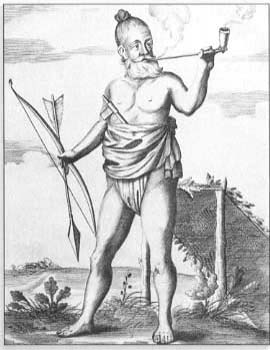
After the origin myth of Väddas and Sinhalas the Mahāvamsa is singularly silent about the former who seem to disappear from Pali chronicles. And therefore I shall begin my account with the history which deals with these forgotten and misunderstood peoples of our history, the so-called "aboriginal" peoples living nowadays in rather poor conditions in the area of Bintanna and Maha Oya. But surely these people had a past, a history if you want to call it that. There are no "peoples without history" but only peoples whose histories have been forgotten or ignored or simply impossible to reconstruct because of the few records they left behind. I therefore want to practice what I call a "restorative" analysis wherein I resurrect the Vädda voices from the past, to depict their presence in history and the complexity of their life-ways prior to their final and sad dispersal, and perhaps the extermination of some of them, during the fateful rebellion against the British in 1817-18, and the less fateful but nevertheless harsh confrontation with agricultural development in the Mahavmäli zone. It is unfortunate that we know the Väddas only from their remnants in the Maha Oya-Bintanne area and that is because as a thoroughly colonized nation we have absorbed the colonial view of the primitive Vädda that in turn has set an indelible stamp on our knowledge of them. Hence I want to initially deal with what Friedrich Nietzsche would call the "genealogy" of the primitive Vädda.
- I want to acknowledge the help of my research assistants, Mr. H.G. Daya Sisira and Ms. Aparna Fernando. I am also indebted to Dr. Wimalaratne, Director of the Sri Lankan National Archives for the help he extended to us; and to Ms. Ramani Hettiaracchi who first pointed out to me the palm leaf manuscripts lying mostly unused in the University of Peradeniya library. The Vadivamsaya, which I mention in this paper, is from that collection. I am also grateful for the Wenner Gren Foundation for sponsoring my Vellassa field project and the International Centre for Ethnic Studies in Colombo for supporting my study of "intermediate texts." I also want to apologize for being unable to systematically employ diacriticals in this text.
"Colonial Histories and Vädda Primitivism" by Prof. Gananath Obeyesekere |
||||
|
• Introduction • Part One: A Genealogy of Vädda Primitivism • Part Two: Vädda Heterogenity and Historic Complexity • Part Three: The Spread and Dispersal of Vädda Lineages • Part Four: Väddas and the Resistance (1817-18) • Part Five: Hunting versus Agriculture, Structure and History • Conclusion | ||||
| Living Heritage Trust ©2024 All Rights Reserved |