
|
|||||||||||||||
The Wanniya-Laetto (Veddahs) of Sri LankaNature Conservation, Human Rights and Indigenous People
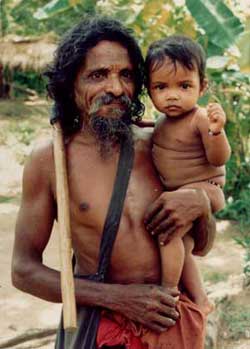
by Wiveca Ann-Chatrin StegebornSubsistence Hunting and GatheringThe subsistence of the Wanniya-laeto revolves mainly around four occupations: hunting and gathering; slash and burn cultivation; livestock herding, combined with temporary employment as unskilled labourers, i.e. digging ditches, carrying soil,, or breaking stones or for road metal road making. The husband goes out nearly every day in search of game and honey. He also gathers edible plants and tubers, so that, in case his hunting luck is not good, he does not come empty handed to his family in the evening. The hunting tools of the Wanniya-laeto are muzzle-loaders and old 12 gauge shotguns, knives and axes. For tropping they employ poles, sticks, twigs and strings, made from the bark of the riti tree (Antiaris innoxia).
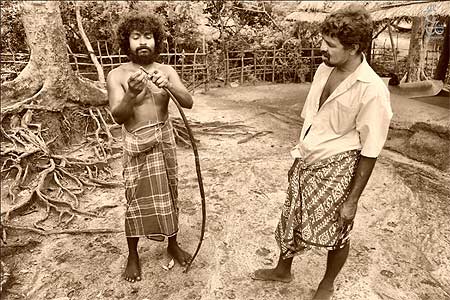
Previously the Wanniya-laeto used bows and arrows. Today these weapons are almost only used for instructing and training young boys. The bows are made of peeled and shaved saplings of the kobbe tree (Allophylus cobbe). Bow-strings are made from the inner cortex of the aralu bark (Terminalia chebula). Arrow shafts must be straight and light; welan wood perfectly suits this purpose. The three feathers used for fletching are from the Forest Eagle-Owl (Huhua nipalensis) or from the Hawk-Eagle (Spizaetus nipalensis kelaartii) or the Crested Honey Buzzard (pernis apivorus ruficollis). Finally, arrow heads are bartered from a blacksmith. Axe heads, knives, gunpowder and shot, also are acquired through barter. Males start to learn the skills of hunting, tracking and 'reading' nature around the age of ten to eleven years. A boy is given his first bow as soon as he is able to hold one, which would be when he is around three years old. This bow is basically built on the same principle as the slingshot; it is strung with two cords, connected at the centre by a one centimetre wide woven fiber mat. A small stone is placed in the mat and firmly gripped between the thumb and the fingers. As the boy pulls the strings and releases the stone, it projects through the air towards its target. Boys play and learn from one another. When they are eight to nine years old, they collect honey together. At the age of eleven, twelve or thirteen years, a boy starts to accompany his father on one-day hunting trips. And of course, the game he catches on a successful day becomes bigger each time as he talks about it. With time, however, he will learn to be less boastful and adopt a more modest posture. He will go out to hunt with his relatives and the other boys from the village. Eventually he will start to contribute to the household. Part of the conversation of the mother at the water hole will be about the boy as he matures. One of the women may take special interest in the stories and keep them in mind until it is time to think about a future spouse for her daughter. Game includes wild boar, macaques and langur monkeys, hares, monitor lizards, pangolins, porcupines, and several kinds of deer, and sambar (Cervus Unicolor). The Wanniyalaeto are not fond of eating birds, neither wild nor domesticated. Some families have four to five chickens freely walking inside and outside their house. They do not keep them in pens. The chickens are kept for the eggs. At night they sleep inside the house by the door.
Typically, as in most hunter-gatherer cultures, the men hunt. Girls are not trained to use the bow, and they are not trained to track animals, listen and interpret sounds, or to engage in any other physical or mental activity / skills related to hunting. Adult women are the primary caretakers of the children. A child may nurse until the age of four to five years. This prolonged lactation serves as a method of birth control. Hence, it is difficult for a mother to leave a dependent child for a whole day. Hunting is considered to be a dangerous activity, with animals behaving unpredictably and perhaps attacking the hunters. Children under the age of ten, of either sex, have no place on the hunt. Because of the obvious physical differences of the writer's height, hair, eye and skin colour compared to the Wanniyalaeto women, the writer was allowed to accompany Wanniya's hunting team in July, 1978. This was the first of about fifteen expeditions planned to last for three to four days. A sister of one of the hunters always accompanied the group if the writer was one of the party. Since women are not trained to handle the bow and arrow, guns, or traps, they are not considered to be members of a hunting party. However, once an animal is killed, there are many chores to accomplish. If the men fell a large animal, it is chopped up and smoked to lighten the burden of carrying it back to the hamlet. Firewood needs to be collected, smoking tables need to be constructed, and the meat is sliced into thin strips. With a large animal such as the sambar, the butchering and smoking may take twelve to eighteen hours. The largest animal taken by the Wanniya-laeto is the sambar. The Wanniya-laeto do not eat elephants. The arrows that the Wanniya-laeto traditionally used would not kill an elephant and it therefore never became part of the traditional diet. The shotguns and muzzleloaders used by modern Wanniya-laeto also cannot penetrate the tough hide of an elephant. Thus, they still do not associate elephants with food. Since hunting success is unpredictable, meat is regarded as a welcome if infrequent addition to the daily diet. The Wanniya-laeto like to eat meat, but circumstances made them predominantly vegetarian. Another much appreciated forest product is honey. As it is nearly always available, it is the main trade item. The flavours vary depending on the seasonal blooming of trees and of wild flowers and from which type of bee the honey comes from. The favorite bees are the Apis indica and the Apis dorsata. Wanniya-laeto families have secret places, passed from generation to generation, where they go to collect honey and beeswax. Gathering is primarily a women's activity in which the writer routinely included. This requires less detailed planning than the hunt, as it is conducted close to home. After a rain, mushrooms sprout in the old chenas (maize and kurakkan millet cultivations) in fallow and the women will go and collect them. Medicinal herbs are also collected by the family of the medicine-man, and the writer often invited along. The shaman's wife, Tale Waruge, Huddi, is a gatherer. Since all her children are grown up, she goes for gathering every day. The medicine-man's wife often joins her. They are approximately of the same age. Although they come from two different villages, and neither came originally from Dambana, they have come to know each other. They came as young brides, brought to Dambana by their husbands. As the writer in the compound of the shaman's family, when in Dambana, the writer often joined Huddi and her daughter, Silawatti in collecting tubers, seeds, plants, fruit, nuts, medicinal herbs or sometimes in cutting straw for the biennial roof thatching. Large parties occasionally form, but only if the resources are plentiful as for example when the trees are heavy with mora (Nephelium longana) and tamarind berries (Dialium ovideum) Owing to the duties of bearing and raising children, the women always return home by the end of the day. There is always someone at the house who takes care of the youngest children, either an older sibling or someone from the extended family. The hunting dog is a life-long partner in the Wanniyalaeto family. He is the lively little playmate for the children when he is a puppy, and the disciplined companion of the hunter when he is an adult. A well trained dog knows when to bark and when to be quiet. If elephants approach at night he has to warn the house but he is not allowed to bark. Instead he runs inside, sniffs his owner and dances around until everybody is alert. Barking would attract the elephants to the hamlet. They seem to connect the dog with cultivation, and recognize that the sound means food, and perhaps salt from burned hearth wood. The domestic dog spends his life like any other member of the Wanniya-laeto family. He is given food when the others eat; he socializes when the others socialize. The only difference is that he sleeps outside at night. Slash and Burn CultivationTo add security to the food supply, most Wanniya-laeto clear a piece of land close to the house to do swidden cultivation. The crops are maize and kurakkan millet (Eleusine coracana) which is their staple food. Swidden cultivation is not unique to the Wanniya-laeto. It is called chena in Sri Lanka and is practiced by both Sinhalese and Tamil small scale farmers. Burnt logs, branches, soil, grass, and charred trunks are built up to form an enormous fence surrounding the chena. It must resist the elephants, be taller than the sambar's leap, and tight enough to keep out the hares. By the end of August the men have completed the clearing of a chena and the fence work. Just before the monsoon in mid-September maize is sown, followed by Kurakkan millet in October. Now it is time for the boys to make use of the double-stringed bow. They guard the chena from birds who come to eat the seeds. After the first rain, the plants manage to grow a little taller, the next forager is the sambar. Wild boars seeking roots are also attracted to the fields. In February it is time to harvest the Kurakkan millet. This is done by the wife and the children. It alleviates the pressure to protect the crops as there is less to look after; there is only maize left. If the crop has survived this far, the main danger still threatens is the elephant. In spite of all the fences they get inside. One animal eats 250-300 kg. of vegetation per day. It does not take him long to rake off a considerable portion of the cultivation during one night's uninvited visit. Finally in March or April the corn cobs are ready and the Wanniyalaeto hurry to harvest before the monkeys steal the crop. Here all the family members cooperate; men, women and children. The ones who do not have their own chenas may be hired for some days to help with the harvest by their relatives. The chena must be guarded night and day. The Wanniyalaeto build watch huts on poles in the middle of the field and in the trees at the edge of it. The husband and sons bear this responsibility. If a boy is too young to be in the watch but alone, he is accompanied by an older brother. In this way the younger siblings learn from the older. Not before a boy reaches 15-17 years does he assume full responsibility to guard the chena alone. If animals come, the watcher shouts and makes noises, hitting buckets with sticks and stones. If elephants threaten, the guards shout for assistance, make torches from bundles of tall grass and chase the elephants away from their homes. The chena cannot be cultivated for more than two to three years. Then it must lie fallow for ten to twelve consecutive years (Spittel 1950: 251) Some Wanniya-laeto families also cultivate a little garden close to the home, where they grow manioc, beans, chilies; curry leaves (Murraya koenigii) pulses, pumpkins and plantains. They may also try to grow some betel vines, but although the betel leaf (piper betel) is highly valued among the Wanniya-laeto, very little of it is raised. Since it is an easy item to pilfer from someone's garden, but it is cheap to buy, the Wanniyalaeto generally obtain it at the local tea-shop. Betel is chewed together with the bitter tasting arecanut from the betel palm (Areca catechu). Before putting the wad in the mouth, a 'pinch' of lime is smeared on the leaf to give it the 'right' taste. To give a mildly spicy flavour to the wad they sometimes add pieces of cinnamon bark, and cardamom seeds. The mastication of this concoction is known as 'chewing betel'. A Wanniya-laeto village, such as Dambana, is composed of a group of houses which are erected in clearings separated from the next village's territory by strips of forest. A house is usually occupied for about two years. When a chena is moved, a new house is built close to it and the old building is abandoned. It soon becomes a heap of mud and sticks. From one year to the next a village may have moved but always it will be found within its recognized territory. Their settlements do not last long enough for a tree to grow and yield a harvest. The areca does not grow wild in the Eastern Province (Seligmann 1911: 329) or in the bordering Uva Province where the Wanniya-laeto live. They therefore buy areca nuts, betel leaves, chewing tobacco, lime, coconuts, spices and edible fruits such as jak fruit (Artocarpus integrifolia) at Sinhalese owned tea shops. Only when they have run out of 'shop betel' do they turn to the forest produce, e.g. When they are hunting or gathering and cannot buy it. betel can be made from the bark of the Demate (Gemelina asiatica) and Davata tree (Carallia intergerrimn) which substitute for the betel leaf and areca nut respectively (Seligmann 1911: 33) Then they collect large, white, land snails (Cyclopliorus involvulus) burn them in fires, pulverize the shells into powder add water to make a paste, and use this in place of lime (Spittel 1950: 252). Trade
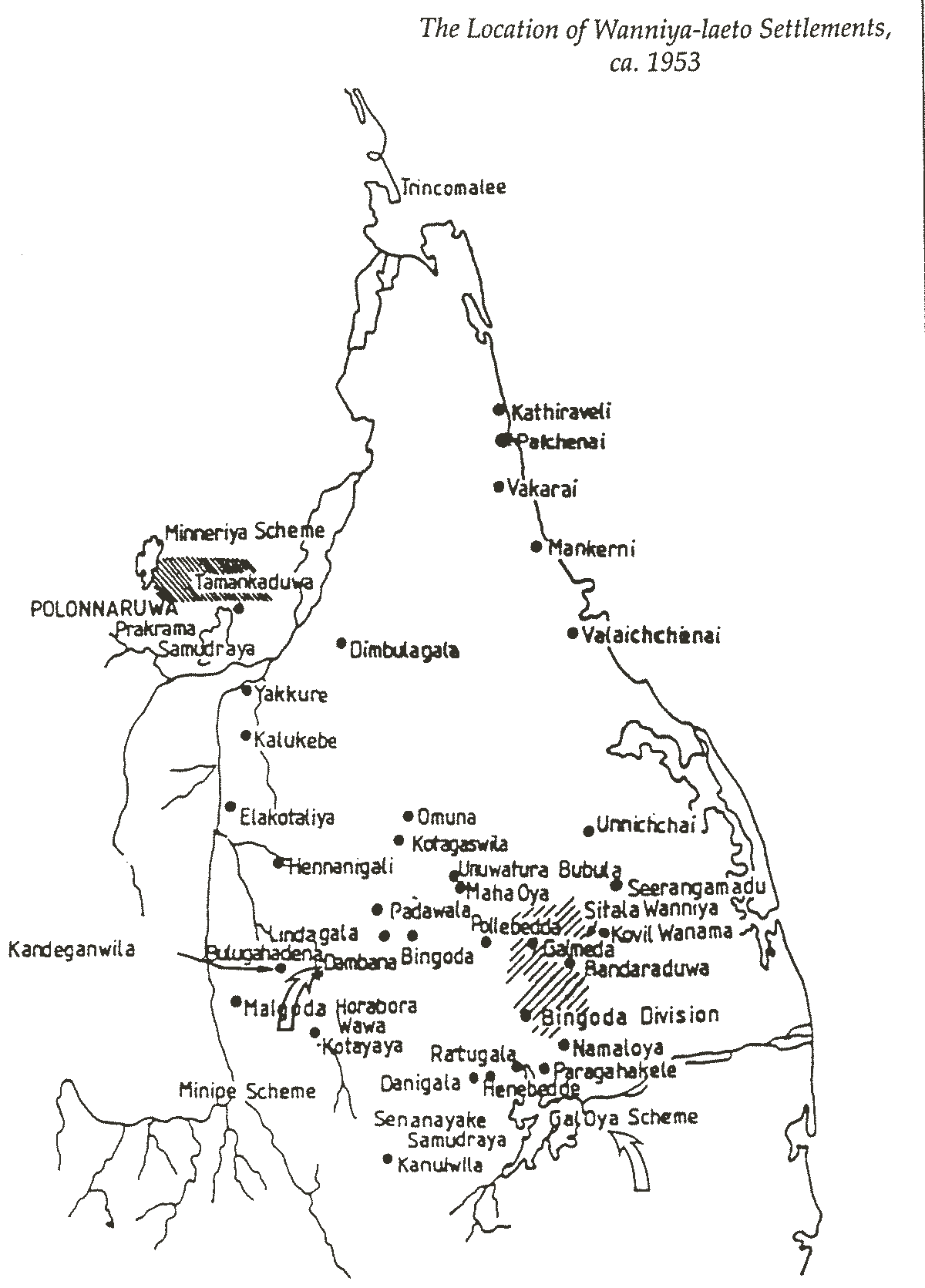
Some items used for trade are honey, meat, medicinal herbs, wild berries, and cultivated grains. The Wanniyalaeto bring their products to the main road where they sell their merchandise to the-shop keepers. With the money they can buy clay vessels, cloth, salt gunpowder, and 'betel.' The first record of trade with the Wanniy-laeto was noted between 337-422 A.D. by Fa Hsian, a Chinese Buddhist pilgrim who lived in Sri Lanka for some time. To quote Fa Hsian: This kingdom had originally no inhabitants, but only demons and dragons dwelt in it. Merchants of different countries (however) came here to trade. At the time of traffic, the demons did not appear in person, but only exposed their valuable commodities with the value affixed. Then the merchantmen, according to the prices marked, purchased the goods and took them away. (Beal 1968: 1 xxii). In the eleventh century, the Arabic geographer Alberini described the 'silent trade' with the savage Ginn (Spittel 1957: 58) And in 1681, Englishman Robert Knox described the wild beasts and men of the island as follows: "They kill Deer, and dry Flesh over the fire, and the people of the Countrey (sic) come and buy it of them." (Knox 1958: 98) Land Use and Acquisition of CattleWithin the last ten years, livestock herding has been adopted by a very few families, influenced by their neighboring Sinhalese agriculturalists. In 1977, only Kotabakinni had livestock. By late 1992, there were at least ten families in Dambana that had herds. The process of cattle acquisition begins with a Sinhalese farmer who needs grazing land for his cattle. The farmers live along the Maha Oya-Mahiyangana road, one and one-half miles from Dambana. He asks the shopkeeper by the main road if he knows of someone who can take care of a small herd of five to ten cattle for him. When a Wanniya-laeto comes to the shop the shopkeeper offers him the job temporarily until he finds someone who wants to earn a little extra money by watching the herd every day. It is a fairly easy work. The cattle graze around the house and sometimes the man's wife or children bring them to other places where there is fresh feed. In addition to the daily pay, which in 1984 was five rupees (ca. U.S. $0.25), they may receive a calf born that year. If they watch several herds, they obtain more livestock, and by the end of two to three years they will have a herd of their own. They milk the cows, boil the milk and drink it, or they make yoghurt. The livestock is kept as security in case of crop failure, or bad hunting luck. Then they use can them to plow their rice-paddies. The Wanniya-laeto do not eat their domestic animals such as their hunting dogs, cats, chicken or the cows they take care of daily. They are considered as pets and part of the compound like the children and the other family members. The mere thought is horrifying and seems barbarous to them. Household animals share their lives with the Wanniya-laeto until the animals die a natural death, or until they are sold. The Wanniyalaeto do not practice endocannibalism and do not eat their dead pets. LanguageThe Wanniya-laeto are thought to be a people who inhabited most of the Indian subcontinent and Sri Lanka (Pearson 1985: 267) before the influx of the Dravidian and the Aryan peoples. According to anthropologist Nandadeva Wijesekera, the Wanniya-laeto language may originate from an 'earlier linguage' (Wijesekera 1964: 104) He states it is a Munda language, one of the ' tribe languages' of India' Subsequently, with the invasion of the island by the indo-Aryans and the Dravidians, the Wanniya-laeto language gradually adopted Elu (an ancient form of Sinhalese) and Tamil words (Wijesekera 1964: 104) The Wanniya-laeto language itself cannot be traced to the Dravidian languages of south India, such as Tamil, Telugu, Malayalam, and Kannarese (Pearson 1985: 68), nor are the people descended from the Indo-Aryans. The linguist M. W. Sugathapala de Silva may help to clarify the classification of the Wanniya-laeto language. He looks at the word 'Wanniya-laeto,' and argues that the Sinhalese People refer to the tropical forest areas of Sri Lanka as the vanni territory. As already noted the word vanniya-latto means 'forest-dweller' (Sugathapala de Silva 1972: 2) assuming that the stem vanni in the Wanniya-laeto language is the same as the Singhalese nominal stem vanni, meaning forest. The suffix 'aeto' (aatto) is commonly used for animate nouns, both in singular and plural forms (Sugathapala de Silva 1972 SOBA / September 1993:27). According to Sugathapala de Silva, the etymology of the word vanni is not certain and he suggests it might be a loan word from the Wanniya-laeto language. He does not explain how, as his book mainly presents transcriptions from the Wanniya-laeto language to Sinhalese and English, but he thinks it is improbable that this word has any connection with Sanskrit, the classic language of ancient India, and the word vana, 'forest, garden' (Sugathapala de Silva 1972: 2) If the word vanni cannot be traced to Sanskrit, an Indo-European language, nor to Dravidian, perhaps this is a language not related to either of the major two linguistic families. Rather the Wanniya-laeto language may be connected to that of other neighboring indigenous peoples of South India, such as the Chenchu. The Chenchu are 'typically Veddoid or proto-Australoid' (Allchin 1966: 79-80 see Appendix) in their physical appearance. Over time they have been strongly influenced by their Dravidian, Telugu neighbors and have adopted their language (Allchin 1966: 110-111). Opinions differ, however. Linguist Merritt Ruhlen divides the Austroasiatic family, which includes the Munda languages, into two branches: the small Munda family in northeast India and the larger, more diverse Mon-khmer family, found in Southeast Asia and on the Nicobar Islands in the Bay of Bengal (Ruhlen 1987: 125) According to Ruhlen's classification, the Wanniya-laeto language is not included in either of the two Munda families. Ruhlen categorized their language as Indo-Iranian, the largest subfamily of the Indo-European family, and so does linguist Barbara Grimes of the Summer Institute of Linguistics in the U.S. (Grimes 1988: 595). The language of the Indo-Aryans, Sinhalese, also belongs to the Indo-Iranian group (Ruhilen 1987: 38). Sinhalese is now the dominant language of Sri Lanka. To exclude a language from a linguistic family on the basis of one word is questionable, but I would like to advance the hypothesis that the Wanniya-laeto did not speak Indo-Iranian or Dravidian before the influence of Indo-Aryans and Tamils. As these foreign peoples migrated to the island, many Wanniya-laeto were absorbed by intermarriage, migration, or relocation, while others maintained their indigenous identity. Those who were not absorbed retained their language but borrowed words from their neighbours. Thus, old component of archaic Sinhalese (Elu) still remain in the Wanniya-laeto language, in the regions where the Wanniya-laeto were influenced by the Sinhalese. Because a civil war broke out on Sri Lanka in 1983, preventing travel to the north and east coast, and because my knowledge of Tamil is limited, I have not been able to record any of the 'Tamilized' Wanniya-laeto. I observed, however, that the Wanniya-laeto of Dambana who visited Yakkuri, one hour's drive north-east of Dambana found it difficult to understand the Yakkuri Wanniya-laeto. Comparison of the transcriptions made by the Seligmanns, Spittel, and Sugathapala de Silva of the Wanniya-laeto language in the areas where they worked, reveal slight differences from the language of the Dambana area. Social OrganizationThe Wanniya-laeto children consider the sisters of their mother as small, middle and/or big-mothers, relative to the age of their real mother. Similarly on the father's side, the biological father (appachi-laeto) and his brothers are addressed as 'father' by their own, and their brothers' children. Cross-cousins are possible marriage partners and the closest kin the Wanniya-laeto can marry. The Wanniya-laeto use special kinship terms for their cross-cousins different from the terms for their parallel cousins. The parallel cousins are considered as siblings and they are addressed with distinct sibling terms according to sex and age relative to go. James Brow, and anthropologist who did a detailed study of villages in Anuradhapura states that the Wanniya-laeto use a Dravidian system of kinship terminology and although there appear to be many similarities to the Iroquois system, there are significant differences such as in the classification of kinsmen beyond first cousins and in the treatment of affines. A Wanniya-laeto girl is marriageable when she is around fourteen years old. The longer she stays with her family, the longer the parents have to provide for her. Her husband may be two to ten years older. Until then she has been a girl, without heavy responsibilities at home. Her duty was to help her mother with the smaller siblings, fetch firewood, carry water, and cook food. Often the young couple's parents will have been acquainted with one another since their own childhood. The girl's parents therefore feel confident when the future son-in-law comes to ask for the daughter as his wife. Marriages are not usually pre-arranged by the parents, although sometimes they have indirect influence. Marriages usually last a lifetime, but if a couple breaks up, the woman returns to her parents with her daughters and the small children. She may also go to her new however, the couple has found someone else. Normally however, the couple has too great a sense of responsibility and of partnership with each other, their children and their extended family to divorce. The husband needs his sons in the hunt and for the preparation and guarding the chena and the wife cannot do without her sisters-in-law and daughters. Until 1989, Wanniya-laeto couples lived together without formal ceremonies or signing of papers. Since 1989, however, the government has arranged mass marriages among the Wanniya-laeto to 'legalize' their life long marriages. Today, even in their own minds, the Wanniya-laeto do not consider themselves married unless they put their fingerprint or signature on an official marriage license. The nuclear family, the consistent face-to-face group, is the base of the Wanniya-laeto society. A Wanniyalaeto hamlet may involve three to nine families clustered together, each family in its own house. An average family includes a husband, wife, and approximately three children. There is no rule requiring patrilocal residence, but this is rather frequent and practical because a set of sons constitutes a trained hunting-team of brothers. Sometimes close collaboration is required by several men to butcher and carry the game back home. Women's gathering activities ordinarily do not require such coordination. This agrees with the anthropologist Service's general statement about hunters and gatherers, that women could be lost to their own family when they marry, and others gained, without weakening it as much as it would be by breaking up the teams of brothers and male cousins who grew up together and share each other's sorrows and joys through childbearing and child raising. As a married woman the young female has to take care of the family and gather the daily food. The mother-in-law is there to console in times of worry and make peace when there is turmoil. As she knows her territory she also knows where the edible tubers the berries, plants, and the seeds. In more than one way she is her daughter-in-law's guide, mother and teacher. If the distance is not too great, the newly married daughter visits her parents and siblings almost every day at the beginning of the marriage. The shift from childhood to adulthood is therefore easier. There is often a close relationship between the descent system and the economy of a society. Matrilineal systems are usually found in non-intensive farming societies, or in horticulturist communities in which women perform much of the productive work (Haviland 1991: 479-484). Such systems are found in the cradles of the old World's food production, in India, Sri Lanka, Indonesia, and south China (Haviland 1991:479), but the Wanniyalaeto are not matrilineal. The Wanniya-laeto affiliate themselves with close relatives through both sexes; in other words, the individual traces descent through both parents simultaneously and recognizes multiple ancestors. One way of knowing this is by listening and recording Wanniya-laeto divination rituals. When a person believes he is haunted by an ancestral spirit, the oldest male of the household will have to determine who among the ancestral spirits is angry. He will name all the dead relatives from both sides of his parents' and his wife's families. Seligmann (1911:30, 74) Spittel (1950: xiv) and Wijesekera (1964:91) classified the Wanniyalaeto as matrilineal. It is not clear from their writing how they arrived at this conclusion. According to Brow (1978) the work of Spittel and Wijesekera were 'theoretically unsophisticated and largely anecdotal' (Ibid. 1978:6). He further states that the Wanniya-laeto's exogamous matrilineality, as described by the Seligmanns has not been critically scrutinized by those who have had firsthand experience of the Wanniyalaeto (Brow 1978:6). Most Wanniya-laeto cannot read and write. They have not read the Sinhalese origin myth in the Mahavamsa, but the epics have been sung or told to them by literate Sinhalese (see below, The Aryan and Dravidian Invasion of Sri Lanka) Parts of the Mahavamsa subsequently been retold among the Wanniyalaeto themselves until it has become an integrated part of their own history. This mythological history narrates that there were no humans, only evil spirits in Sri Lanka before the Sinhalese conqueror Vijaya arrived. Vijaya had a son and a daughter with Kuveni, a female spirit from Lanka. Those children were the first Wanniyalaeto. The siblings grew up and reproduced. The present Wanniya-laeto are, according to the Mahavamsa, the result of that relationship. The Wanniya-laeto trace their ancestry from both of these individuals, but do not distinguish any type of lineage organization. The Wanniya-laeto who do not embrace the Mahavamsa story believe their ancestors have lived on Sri Lanka since time began, and do not trace their descent from any specific progenitor. There are no full time specialists among the Wanniyalaeto. The shaman, for example, only exercises his craft upon request. He passes his days like everyone else, hunting, collecting honey, and working on his chena. His sons may or may not become a shaman. No one insists, if the sons are not interested in learning the skills of the father. Any Wanniya-laeto who feels ready to learn about the spirit world can ask other shamans. Women, children and old people do not engage in shamanism as it demands physical strength to perform the ceremonial dances, sometimes for two full nights and days. It is also not morally 'good' for a woman to-walk from hamlet to hamlet. She is supposed to be at home and take care of the house and the children. While letting the spirits take possession of the body the dances can become very intense, with shaking, shivering jumps, swirls, and leaps. It is not socially acceptable for a woman to perform such acrobatics as the movements are not considered feminine. It the father dies, the oldest son assumes responsibility for his mother and siblings, that is if he is old enough to hunt and take care of the chena. Hence, he takes his father's tools and continues the work. Eventually he will form his own family. Therefore when the annual cycle of the year is closed and the crops harvested, the widow moves back with her parents. If her parents are not alive she may marry an unmarried brother or a relative of the deceased husband, who can take care of her. Polygynous levirate is not customary among the Wanniya-laeto. It is economically too burdensome for Wanniya-laeto man to maintain two women. In some instances two sisters marry two brothers, in that case the widow may remain in the deceased husband's hamlet and carry on with her chores as she has her sister there. Inheritance in a Wanniya-laeto family is divided equally among the sons (Tambiah 1958;23). A daughter who has married and moved to live patrilocally with her husband becomes separated from her parental family and therefore shares the inheritance acquired by her husband. The children automatically share the family name of the father. In the case of matrilocality the daughter inherits equally with her brothers and her children carry the same family name as she does. Matrilocality does not happen frequently, but if there is a lack of sons in the family or they are very few, the daughter may settle by her parents' house with her husband to bring up heirs to the family (Tambiah 1958:23). It the wife dies, the mother of the deceased may retrieve the cooking utensils. She gave those to the daughter's new household when she married. As the widowed hunter cannot alone take care of the small children, the mother of the deceased therefore takes them home to her house. The teenaged sons may choose to stay with their father. Clothes and private belongings of the wife are burned or buried with her body. The Wanniya-laeto find it emotionally difficult to see someone else wearing their mother's/wife's or daughter's clothes. Dwelling in the past too long is not regarded as healthy. In the best of circumstances the husband may still marry an unmarried sister of his former wife. In that case affinities and old routines can continue like before. A non-affiliated new bride will require new adjustments for the hamlet. The Wanniya-laeto can be classified as sedentary people, as they generally stay at one place for several years. Normally the group moves together and the new site is located quite near the old one. Nevertheless a hamlet is an ever changing organism. It expands and contracts depending on the needs of its families and contracts depending on its needs of its families and the resources available. Sometimes a man with his family will move to the hamlet where his sister is living because more men are needed, or because food is scarce at his own settlement. In this instance, the brother should be of the same generation as his brothers-in-law, as a man of the same age as the patriarch may disturb the hamlet. Immediately his children become fictive siblings to the other children in the hamlet, and although they are cross-cousins they will most likely not marry any of their 'brothers' or 'sisters' in their paternal aunt's compound. The kin terminology is very flexible. It serves to accommodate the biological and social realities and it softens the formal rigour of the age grades (Brow 1978:72). When a hamlet becomes too big and the environment becomes exhausted, the extended family divides into two or more groups, each forming a new camp. There are no headmen or chiefs in the forest. Leadership is based on recognized ability in different activities. Full time specialists and differentiated economic, political and religious institutions are alien to the Wanniya-laeto. They do have shamans and people who know about herbal medicines, but other than the family itself is the group that fulfill all roles. The division of labour is based on age and sex. The only consistent supremacy of any kind is that of a person of higher age and wisdom who might lead a ceremony. A person with a special skill may be asked to give advice or occasionally to lead. A hunter with sharper eyesight may walk some steps ahead of the others when searching for game. The Wanniya-laeto base their identity in their role as a son/ daughter, wife/husband, father/mother, uncle/aunt and friedn rather than in the skills they may possess. No one is a professional i.e. a bus driver, a car mechanic, or a banker. Leadership is taken up by one person or another depending on the type of activity being planned. The hot climate and sometimes the high humidity, during the monsoons, allow nothing to remain fresh for more than a day. These environmental factors have influenced the development among the Wanniya-laeto of a lifestyle of balanced reciprocity. It is therefore a bad investment to store and save. Accumulating goods promotes envy and distrust, and reduces the prestige and esteem that a person normally might enjoy. Instead, the Wanniya-laeto give things away, and giving has to be done modestly. The word 'gift' has overtones of charity and is considered to be damaging both to the giver and the receiver if s/he is put on an inferior level or in a situation of dependency. There is no such phrase as 'thank you' in the Wanniya-laeto language. The giver is happy that his 'gift' is accepted. The opposite would be terrible. It could be a sign of resentment. The Wanniya-laeto admire generosity and hospitality and punish thrift as selfishness. Reciprocity is based on the fact that the people who exchange are going to be associated for a very long time. In the long run things even out. No one is denied access to the natural resources on which all of them depend. No individual owns the forest. The families have equal rights to acquire these resources but each extended family knows its traditional hunting and chena circles and those are respected by others. The Wanniya-laeto system is a complex of rights and duties, with compromises and agreements made directly between the community members. Warfare is unknown in modern times and as the Wanniya-laeto do not write their language there are no written sources of such occurrences. Other than the men who were used as bow-men by the Portuguese against the Dutch (see next chapter), I have not read or heard of other types of warfare. Colonization by foreign powers has reduced the indigenous population to a very low level. Resistance against outsiders taking their land means retreat farther into the forest. The Wanniyalaeto do not have the economic base to sustain a military effort for a protracted period. The Wanniya-laeto are not accustomed to being organized that can mobilize or draft warriors, direct them, and give them reasons to fight, a war cannot be conducted. Secondly, there is not much to gain by plundering other Wanniya-laeto people. There are no standard items of exchange that serve as capital or as valuables, and the material wealth of these hunters and gatherers is inconsiderable. Justice as employed by the Wanniya-laeto is based on common understanding. Relatives and friends of the accuser and the accused discuss and negotiate with each other until an acceptable agreement or a compromise is made. Direct confrontation between the parties is not the rule. After the consensus the two main protagonists meet directly to clarify and to confirm what they have agreed to, mediated by their delegated relatives. This is usually accomplished in a polite and cordial manner, which prescribes a symbolic contribution of betel by the accuser to the family of the defendant, who in return is invited to share a meal with them. Both parties find it equally important to maintain good relations and peace between the hamlets. ReligionThe Wanniya-laeto believe that their dead relatives are always with them although they live in another dimension. Their belief embodies the thought that no one really dies until those who knew him and loved him are also dead. The closest spirits are the recently dead family members, the Nae-yakkha.1 These forefathers' spirits stay permanently close to the abode in order to help in daily life. They stay in trees, hills, streams, caves, and rocks and they protect the Wanniya-laeto with loving kindness day and night. As a rule they are benevolent, but just as when they were alive, the ancestors can feel offended or neglected. As they cannot communicate their annoyance verbally they make the living relatives understand in other ways. They send elephants, wild boar, or monkeys to eat from the Wanniya-laeto chena, or they send rats and insects to infest the harvest of maize and Kurakkan millet. When the father and the sons track game, they soon realize the hunting spirits are absent as no animal appears in front of their muzzle-loader. Wrathful forefathers may even let leopards or bears attack the hunters. The family has to know who and what is causing the anger of the spirits and invites them, the yakkhu, to come to a yakkhuma, 2 a healing ritual with offerings to appease them. In the course of time the spirit of a dead person loses its individuality and enters into a general spirit world without a name, the sphere of the long forgotten naeyakkhu. The spirits of the more recently dead replace the older as they are better known to succeeding generations. The Wanniya-laeto also honour great hunters and heroes/heroines who lived earlier. The most important hunting spirit is kande Yakkha, the spirit of kande Wanniya, a celebrated hunter who lived many generations ago. Another is Kalu Bandara Deviyo who, states U.W. Wanniya, is the elder brother of the legendary Kuveni. He advised Kuveni's son and daughter, the first Wanniya-laeto according to the Sinhalese legend, Mahavamsa, about their arrival in Sri Lanka, to run and hide in the forest after their mother had been killed. The name reveals an influence from the Bandara cult of the highland Sinhalese. The addition of either deviya (pl. devio) or yakkha behind a spirit's name is arbitrary (Seligmann 1911:144 n.2). A yakkha for the Wanniyalaeto is simply a superhuman being, a god, a dead relative, or a malicious spirit. The yakkha does not necessarily have to be evil. Quite to the contrary, most of the spirits are the beloved forefathers. Aside from the famous spirits mentioned above, there are also well known local and family spirits living in the forest. They frequent mountains, caves big trees and streams. Each locality carries its own story about the spirit (s) who live there. It is important to re-emphasize the importance of the land for the Wanniya-laeto both mythologically and etymologically. When government planners decided to relocate the Wanniya-laeto from their ancestral homeland to other areas similar to their previous habitats, they did not consider that the forest of the Wanniyalaeto encompasses both people, their forefathers, their gods and spirits. It cannot be exchanged for money, property or other land.
This article appeared in the September 1993 issue of Soba published by the Ministry of Environment of the Government of Sri Lanka |

| Living Heritage Trust ©2024 All Rights Reserved |